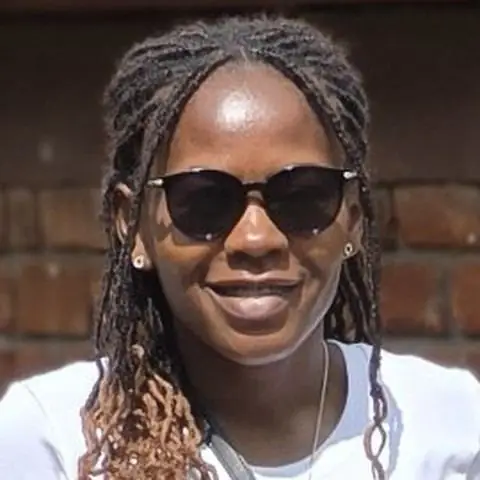
Meril Adoyo
Meril leads RAFIKI Outreach in Kenya from the Kitale office. She works with communities from their first request through site selection and drilling, and stays in touch long after the well is finished, so every project leaves water flowing for years to come.
meril@rafikioutreach.org Morgan MamatiRAFIKI Kenya
Our work in Kenya
Most of our work in Kenya is around Eldoret, in Uasin Gishu and Nandi counties, with projects near Kisumu and Naivasha too. Our Kenya management team builds long relationships with schools and communities, from the first request to years after the water flows, and for some of them our work goes beyond the well, to classrooms, a health dispensary and livelihoods.
What we do
Who we serve
Where we work
Where our projects are
{{mpCap}}
Some pins mark the village or town rather than the exact site. Place data © OpenStreetMap contributors.
{{mpSelLive}}
Choose a dot to see the projects there.
{{mpUnH}}
- {{r.t}}{{r.a}}
Our impact in Kenya
RAFIKI has worked in Kenya since 2021.
{{impMore}}
{{sgH}}
Chepkongi is a community in Kapsaret, Eldoret. Families here used to walk about 6 miles to fetch water from the Sosiani River, which is not safe to drink, and about 8 miles to reach health care. Our work began with water: a borehole and elevated tower for the dispensary, and another for the primary school.
{{sgWell}}
With water on site, we went on to complete the dispensary: plumbing and electrical work, beds, furniture, medical equipment and medicines, an incinerator for medical waste, and a fence and gate. Care is now close to home, so people walk far less and the community is healthier.
{{bwH}}
{{bwLead}}
Under way, next and recent
Projects in Kenya
Projects in Kenya
Project name, place, year
People served
Project name, place, year
People served
Project name, place, year
People served
Recent projects
Recently finished water projects in Kenya. Each photo opens that project.
- Two or three written stories from Kenya, each with a photo and a few words from the community
The need for safe water in Kenya
More Kenyans drink straight from rivers, dams and ponds than in any other country where RAFIKI works, and the gaps are widest in the countryside around our projects.
Kenyans lack even a basic drinking-water service. About 9 in 10 of them live in rural areas.
WHO/UNICEF JMP, 2024 (our calculation)of Kenyans drink untreated surface water from rivers, dams, ponds or streams. In rural areas it is 1 in 4.
WHO/UNICEF JMP, 2024of people in Nandi County have a basic water service, compared with 79% in neighbouring Uasin Gishu.
Kenya DHS, 2022of groundwater samples from domestic wells in Kenya’s Rift Valley exceed WHO’s fluoride limit of 1.5 mg/L.
Mwiathi et al., 2022Basic access in Kenya rose from 58% of people in 2015 to 66% in 2024, but the divide between town and country is wide: 89% of people in urban areas have a basic service, against 56% in rural areas. There is not yet enough water-quality data for WHO and UNICEF to estimate how many Kenyans have safely managed water.
Sources: WHO/UNICEF JMP, 2024
Most of our Kenyan wells are in Uasin Gishu and Nandi counties, around Eldoret. Uasin Gishu’s averages are lifted by Eldoret town, yet about 12% of people there still use unprotected wells. In Nandi, fewer than half of people have a basic service and about 1 in 4 drink surface water. In Trans Nzoia, home to our Kitale office, 40% depend on protected hand-dug wells and nearly 1 in 5 live more than 30 minutes from water. Where water has to be fetched, a woman or girl does it for 75% of Kenyans, and for nearly 9 in 10 people in Nandi.
Sources: Kenya DHS, 2022
At Mt Longonot, near Naivasha, the problem is what is in the water. The Rift Valley’s volcanic rocks release fluoride into groundwater. Nakuru County names Naivasha as its worst-affected area, with Longonot and Maai Mahiu among the high-risk places. Water can look clean and still harm teeth and bones over time, and boiling does not remove fluoride, yet a 2026 study in Nakuru found 65% of residents relying on fixes like this that do not work. Our project at Longonot DEB Primary School is a reverse osmosis treatment system that removes fluoride, so the children have safe water to drink.
Sources: Mwiathi et al., 2022 · Kenya News Agency (Nakuru County) · Okore et al., 2026
“Basic” water means an improved source, such as a borehole, protected well or tap, that takes 30 minutes or less to reach and collect from, including queuing. “Safely managed” means water at home, available when needed and free from contamination. Figures marked “our calculation” apply the WHO/UNICEF percentage to the population estimate WHO/UNICEF use. National surveys (DHS) and WHO/UNICEF estimates are measured differently, so their figures can differ slightly.
Current needs in Kenya
{{cp.ke.needL}}