Rain for the bomas
Maasai families here live in bomas, extended-family homesteads. For each boma we build a tank that collects and stores rainwater close to home.
RAFIKI to confirm tank size (litres) and how the rain is collected

Water projects for villages, schools, churches and health clinics, built by our team with local contractors and community representatives.
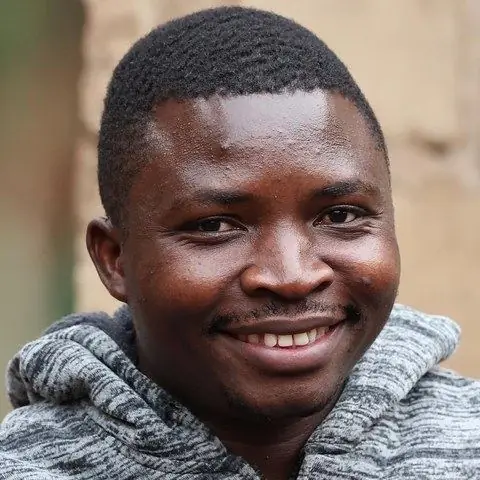
Bertin leads RAFIKI Outreach in Tanzania. He started as our Drill Master and knows every well from the ground up, from choosing the site to the moment clean water reaches the surface. Today he guides the Tanzania team and the communities they serve, making sure each well is built to last.
bertin@rafikioutreach.orgMost of what we do in Tanzania is water, and each project is planned together with the community it will serve. Beyond the well, we also support schools, health clinics, children’s homes and livelihoods projects.
{{mpCap}}
Some pins mark the village or town rather than the exact site. Place data © OpenStreetMap contributors.
{{mpSelLive}}
Choose a dot to see the projects there.
RAFIKI has worked in Tanzania since 2022.
{{impMore}}
Most of our work in Tanzania takes two forms: rainwater tanks for Maasai families in Arusha Region, and village boreholes around Babati in Manyara Region.
Maasai families here live in bomas, extended-family homesteads. For each boma we build a tank that collects and stores rainwater close to home.
RAFIKI to confirm tank size (litres) and how the rain is collected
Around Babati we drill a borehole for each village or sub-village (mtaa), working with local drillers and village leaders. Each one is looked after by a local water committee or named caretakers.
{{sgBabPump}}
A short note from Bertin on how a Babati site is chosen and handed over, to add
{{bwLead}}
The project list could not be loaded just now.
Our projects come straight from our project records. Please try again in a few minutes.
Loading the project list…
Recently finished boreholes in Tanzania. Each photo opens that project.
More people lack basic water in Tanzania than in any other country where RAFIKI works. In Manyara, where most of our wells are, distance and fluoride make it harder still.
of 225 boreholes tested across Manyara Region exceed WHO’s fluoride limit of 1.5 mg/L.
Kitemangu et al., 2026of people in Manyara live more than 30 minutes (round trip) from water, about double the national rate of 14%.
Tanzania DHS-MIS, 2022dams in Monduli District, Arusha Region, dried up in the 2021–24 drought.
The Citizen, 2025Tanzanians lack a basic drinking-water service. Only 23% of rural people have safely managed water.
WHO/UNICEF JMP, 2024 (our calculation)Tanzania has made the fastest progress of the four countries where we work: basic access rose from 51% of people in 2015 to 65% in 2024. That still leaves about 24 million people without a basic service, and in rural areas fewer than 1 in 4 people have water that is safely managed. The government’s rural water agency, RUWASA, reports rural water coverage of 85%. National “coverage” figures use different definitions from the WHO/UNICEF service levels used here, so the two cannot be compared directly.
Sources: WHO/UNICEF JMP, 2024 · Daily News / AllAfrica, 2026
Around Babati and Magara in Manyara Region, only half of people (50%) have a basic water service, and nearly 1 in 3 live more than 30 minutes from water. Manyara also lies in northern Tanzania’s fluoride belt. In a 2026 study of 225 boreholes across all six of its districts, 48% exceeded WHO’s limit and 3.6% had more than 10 mg/L, the level linked to crippling skeletal fluorosis. Fluoride can vary sharply between boreholes a short distance apart, so researchers recommend siting and testing every borehole with care.
Sources: Tanzania DHS-MIS, 2022 · Kitemangu et al., 2026 · Ijumulana et al., 2022
In Arusha Region, Maasai pastoralist communities depend on dams and seasonal sources that fail in drought. In Monduli District, 61 of 64 dams dried up between 2021 and early 2024, and women walked 15–20 km for water, setting out at midnight. In Simanjiro, where we have also drilled a well, about 90,000 livestock died in an early-2022 dry spell as water sources dried up. Where water has to be fetched in Arusha Region, a woman or girl does it in about 9 out of 10 cases.
Sources: The Citizen, 2025 · The Citizen, 2022 · Tanzania DHS-MIS, 2022
“Basic” water means an improved source, such as a borehole, protected well or tap, that takes 30 minutes or less to reach and collect from, including queuing. “Safely managed” means water at home, available when needed and free from contamination. Figures marked “our calculation” apply the WHO/UNICEF percentage to the population estimate WHO/UNICEF use. National surveys (DHS) and WHO/UNICEF estimates are measured differently, so their figures can differ slightly.
{{cp.tz.needL}}